Listen and subscribe on Apple Podcasts, Spotify, and all major podcast apps.
Kelly McEvers: It’s a chilly day in a tiny town in West Virginia in the Appalachian Mountains. Winter is almost over. In the middle of town is this little wooden dance hall that was built in 1910. Inside there are fiddles playing and feet stomping on the floorboards.
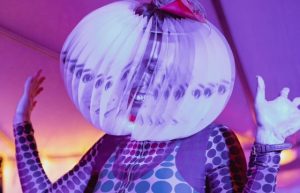
Clara Lehmann: And then the sun starts to go down and the doors of the dance hall open. And all of these characters wearing huge papier-mâché masks come parading out. You know, people dress up as frightening things, whimsical, scary-looking beasts, or it might be something very beautiful. I’ve seen masks that have streamers of color coming out and very vibrant colors.
Kelly: This parade of beasts and aliens and flowers and suns and moons makes its way into a field. They’re holding lanterns. And as the sun gets lower and it gets darker outside, the light from the lanterns makes everything seem strange and unreal.
Clara: The way that the sounds echo when you’re in the mask are very fascinating because you’re having a great time. There’s music, people want your picture and they want to talk to you, and you can’t quite hear them. So it’s kind of this lovely, confusing experience. It allows you to be something else for the day and be an observer and observed.
Kelly: I’m Kelly McEvers, and this is Atlas Obscura, a celebration of the world’s strange, incredible, and wondrous places. This episode is brought to you in partnership with West Virginia Tourism.
And today we’re going to Fasnacht. It’s a day of celebration, revelry, and a little bit of mischief to celebrate the end of winter. A tradition that has been around for a long time, but was almost lost in West Virginia until two local women saved it.
This is an edited transcript of the Atlas Obscura Podcast: a celebration of the world’s strange, incredible, and wondrous places. Find the show on Apple Podcasts, Spotify, and all major podcast apps.

Kelly: Fasnacht is the signature event in a town called Helvetia. It’s close to the very center of West Virginia, high in the Allegheny Mountains, one of the more rugged parts of the Appalachian Mountain chain. Helvetia is not easy to get to.
Clara: You end up driving at least an hour to get to Helvetia on very windy roads. It is the middle of winter, often very cold. Sometimes we have a couple feet of snow.
Kelly: This is Clara Lehmann. She’s a filmmaker who lives in Helvetia and grew up there. And today she’s the director of the Fasnacht Festival.
Clara: People feel like they are paused for a moment when they go to Helvetia. There’s no cell phone service. It’s quiet. There are no highways. You’re definitely driving on winding roads. And the community, while we’re small, is very welcoming and warm and wants to have you here.
Kelly: Small, meaning a population of around 60. But at the end of every winter, when the annual celebration of Fasnacht comes around, the town grows to 20 times its size.
Clara: This is not a modern tradition. It’s very, very old.
Kelly: The story of Fasnacht in Helvetia goes back to the founding of the town in 1869. That’s when five Swiss families moved to Helvetia from Brooklyn. The mountains, they said, reminded them of home.
One of the earliest recorded celebrations of Fasnacht was in the 14th century in Basel, Switzerland. It probably goes even further back than that, to a pre-Christian ritual that marks the coming of spring.
Clara: Fasnacht, interestingly, is German for “fasting night.” “Fas” meaning fasting, “nacht” meaning night. But more recognizably, Fasnacht is Mardi Gras. It’s supposed to fall on Fat Tuesday because you would eat all your fatty foods on Tuesday, and then on Wednesday you begin Lent.
Kelly: The big party of Fat Tuesday or Fasnacht is supposed to get you through the next 40 days of fasting. This fasting, of course, comes from religious traditions, but Clara says it’s practical, too.
Clara: In the time that my ancestors came from Switzerland, a lot of them were farmers, and so they’re that — you are reliant on the land. They have harsh winters, and you oftentimes had to put a lot of resources away in order to make it through winter. And this was the one day in that winter time that you were allowed to really let go, be like, I’m gonna have a drink. Oh wait, I’m gonna eat that extra potato. I don’t know.
Kelly: Indulging in that one potato led to other forms of indulgence. Over the years, Fasnacht and other Mardi Gras traditions became associated with masquerades, parades, music, and mischief.
Clara: That’s a very important element to Fasnacht. It allows a community to get together, be a little bit curious and odd, and play different roles or poke fun at neighbors or politics in a way that is safe.
Kelly: But while Fasnacht celebrations in Switzerland are these big carnivals, Clara says the early Fasnacht in Helvetia were very different.
Clara: Originally, a lot of our community members celebrated this privately in their homes. You bring the homemade wine, I’ll bring a homemade dish, we’ll make some rosettes, which are a fatty, fried, like a donut or like a funnel cake, but it’s in the shape of a beautiful flower. And then we’ll share and we share food together and we play music and we sing.
Kelly: So that was how it was originally done in Helvetia. But then things changed after World War I and World War II.
Clara: In the 1940s and ’50s, there were anti-German sentiments that were still hanging over Helvetia, and that was due to the world wars. And so there was a lot of antagonism that was happening, and so the community started to shun its Swiss identity in order to protect itself.
Kelly: During this period, Fasnacht was almost lost. But then two local women got involved. Their names were Eleanor Mailloux and Dolores Baggerly, and they ran a restaurant together. Eleanor was Clara’s grandmother. Clara sometimes calls her Mueter, the Swiss German word for mother. And Clara remembers trying to get a look at her grandmother’s Fasnacht mask in the back of the restaurant.
Clara: And I would sneak back into the winter part where she would have her mask drying by the wood stove and see what she — I thought she was building. You know, it’d be very rudimentary early on, so you wouldn’t know.
It’d be like, oh, I wonder if it’s gonna be gruesome or pretty, and she usually leaned gruesome. So in the 1960s, ’70s, the community was having struggles economically, with retention, with upkeep, you know.
Mueter and Dolores were like, man, we really need to figure out ways to remind people that this identity is special. And also, how can we make sure that the little restaurant and the little post office in the library can survive?
Kelly: So Dolores and Mueter Eleanor started decorating their restaurant with Swiss folk art and making traditional foods. And they decided to make Fasnacht a public celebration.
Clara: And so that first few years, it was Dolores and my grandmother dressing up in masks only. There were maybe two or three masks. Eleanor Mailloux wore a mask with big antlers. She made it out of papier-mâché, and then a lot of folks hunt in our area, so she had some antlers laying around and attached them and became some kind of beast of the woods. There are stories of children remembering that year because they were scared of both of these women.
Kelly: It wasn’t until the 1990s, though, that the festival really took off. That’s when a local psychology professor at West Virginia University named Rogers McAvoy encouraged his students to go to Fasnacht and to mask up.
Clara: And sometimes they were the more masked participants than even our local individuals.
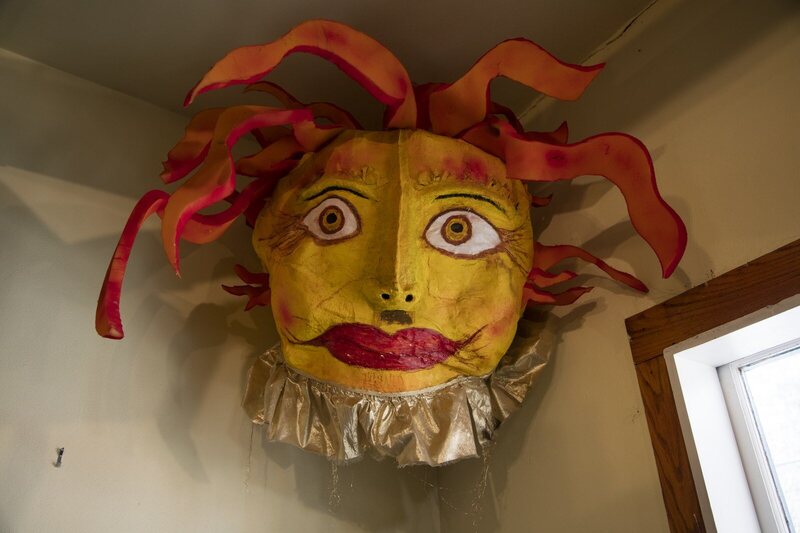
Kelly: Today, masking is a huge part of the Fasnacht Festival in Helvetia. Usually, people make the masks out of papier-mâché and work on them for weeks or months.
Some are more gruesome, like Eleanor’s, to scare away Old Man Winter. Others are more about welcoming spring with flowers and suns. And some are just weird.
Clara: People really put themselves into these masks. They’re pieces of art. I’ve seen a group of possums, that was adorable. I remember one year there was a mask that had a battery pack in it with a mouse running in a wheel placed inside, as if it was a part of the brain.
Kelly: Sometimes the masks are a commentary on things that have happened in town during the year.
Clara: One year we had a couple who dressed up as a cow and a milkmaid, and that was to poke fun at the fact that someone in our community had tried to have dairy and it didn’t work out. And so there were things that you can laugh about and release. It’s letting you release something that maybe you have been holding on to, and it’s like, hey, let it go and let’s move on.
Kelly: Letting go and moving on is a big part of Fasnacht. First, you eat the rosettes and the other fried food, then you jam and dance in the dance hall, then you parade out into that field in your costumes. And then it’s time to say goodbye to Old Man Winter.
Clara: We untether Old Man Winter, who we have propped up inside our gazebo. It is papier-mâché or a mixed media. It’s a human form of an Old Man Winter, and we take him across the little footbridge and down the road to a large bonfire, toss him on the bonfire, and then we have a nice big square dance in the community hall after that.
Kelly: These days, about a thousand people come to Fasnacht every year, and that’s a big deal. When you remember, the town usually has only 60 people living in it.
One reason the festival has grown over the last few years is actually a video game. It’s called Fallout 76, and it’s a post-apocalyptic survival role-playing game. One popular update lets you wander around a virtual Helvetia and participate in a virtual Fasnacht.
Clara says people in town love it because the more people hear about Fasnacht and come to Fasnacht, the more strange it gets.
Clara: This is a little weird, and I will admit it’s weird. Seeing a thousand masks or, you know, people dressed oddly is strange in the middle of Appalachia, but it’s really special. And I think that sometimes people come away from it with a spiritual experience, and that can be religious, it can be catharsis, it can be slightly just healing.
And I think that’s a point is to bring community together and celebrate who we are, wherever we are, and however we are, and then allow ourselves to make it through the last little bit of winter before spring comes and heals us even more and lets us get back together uh in warmth.
Kelly: The date of Fasnacht changes every year with the Easter calendar, just like Mardi Gras. Check the episode description for more details.
Listen and subscribe on Apple Podcasts, Spotify, and all major podcast apps.